The Issue

The digitalisation of health systems and rapid development of digital tools and Artificial Intelligence (AI) for health has increased the amount of health (and health-related) data that is collected and used. Health data needs to be effectively and equitably governed to ensure the right protections are in place to safeguard data privacy and rights, and mitigate risks of data misuse; while also supporting responsible data use for public benefit.
More robust health data governance will lead to:
Enable digital transformation and artificial intelligence
Advancements in research and innovation
Improve data-driven decision-making
Support health care professionals
Strengthen equitable and resilient health systems
Improve health emergency and pandemic response
Empower individuals to achieve their personal health goals
Enhance healthcare delivery and outcomes, towards UHC
Health data governance should be guided by equity and rights based principles, while ensuring robust legislation and regulations at national level. This is important to build public trust in health data systems; and to fully harness the value of health data as both an individual and public good. A global and regional health data governance framework can help build consensus across countries around needed legislative and regulatory provisions, which would in turn support countries in strengthening national frameworks.
As attention focuses on the opportunities (and regulation) of AI, health data governance must be central to this, as highlighted by the expert panel hosted by the WHO during the recent Strategic Roundtable on Artificial Intelligence at the 77th World Health Assembly. Health data governance is pivotal to AI governance; and responsible AI in health is unattainable without robust health data governance.
The need to strengthen health data governance is increasingly recognised by governments and across global and regional frameworks, strategies and commitments. This includes the recently endorsed Global Digital Compact; WHO Strategic Roundtable on Artificial Intelligence, as well as government co-hosted events at the 77th World Health Assembly; High-level Advisory Body on Artificial Intelligence; “International Data Governance – Pathways to Progress” report of the United Nations System Chief Executives Board for Coordination; outcome statement of the 2021 WHO Health Data Governance Summit; Global strategy on digital health; AU and Africa CDC digital transformation strategies; and as part of G20 and G7 discussions.
Advocating for a global and regional health data governance framework
Since its inception, Transform Health has been advocating for a global and regional health data governance framework (underpinned by equity and rights-based Health Data Governance Principles) to be endorsed by governments through a World Health Assembly resolution, as well as through regional mechanisms, which would in turn support countries in strengthening national legislation and regulation.
While several countries and regions are taking steps to strengthen health data governance, approaches vary. We believe that there is value in countries and other stakeholders coming together to develop and endorse a global and regional framework, which serves as a key step towards more robust national legislation and regulations by:
- Building country consensus and commitment around a global standard for health data governance and essential areas that should be addressed through national legislation (based on countries experiences and good practice);
- Establishing a level of compatibility in national approaches to foster greater legal coherence across jurisdictions (which is important for cross-border data sharing);
- Providing a blueprint and flexible framework that governments can use as a resource to strengthen national approaches.
Learn more about the need for more robust health data governance and what we are calling for.
Transform Health’s work on health data governance
Transform Health is working with partners at national, regional and global levels to advocate for and support more robust health data governance, including:
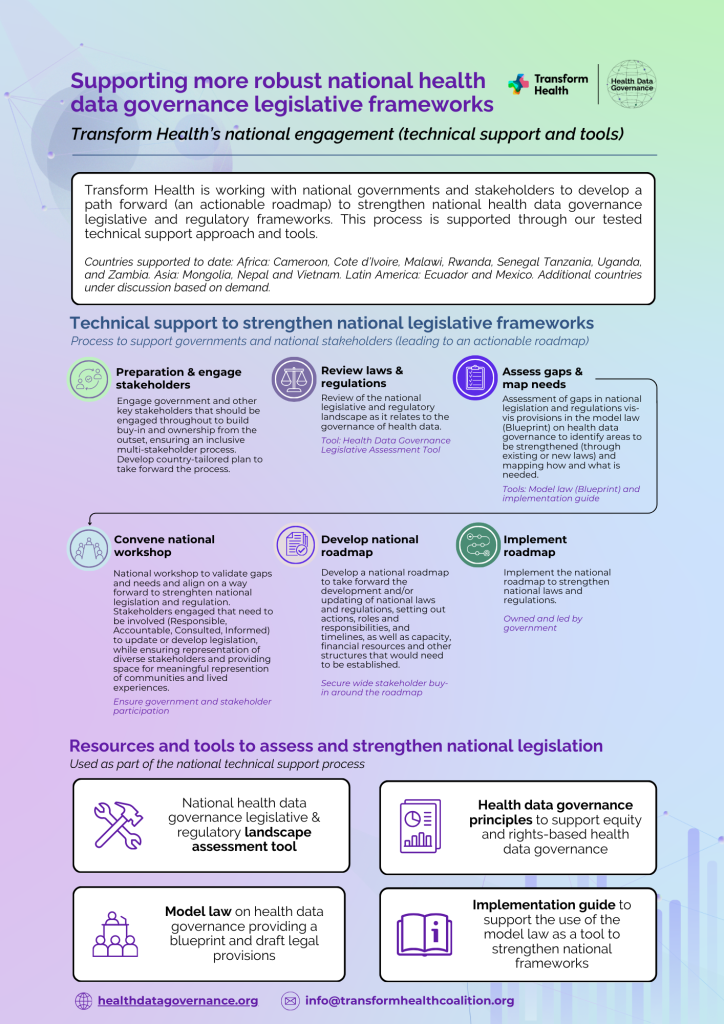
- Stewarding the development of a set of equity and rights-based Health Data Governance Principles
- Developing a Model Law on Health Data Governance with an accompanying Implementation Guide
- Developing a national health data governance legislative assessment tool and conducting national landscape reviews across numerous countries.
- Working with decision-makers to build political support for more robust legislation and regulation and a global and regional framework, including convening discussions with decision-makers and stakeholders to build consensus and action.
- Raising public and political awareness on the issue through the My Data Our Health campaign.
- Working with national governments and stakeholders to develop a path forward (an actionable roadmap) to strengthen national health data governance legislative and regulatory frameworks, This process is supported through our tested technical support approach and tools.